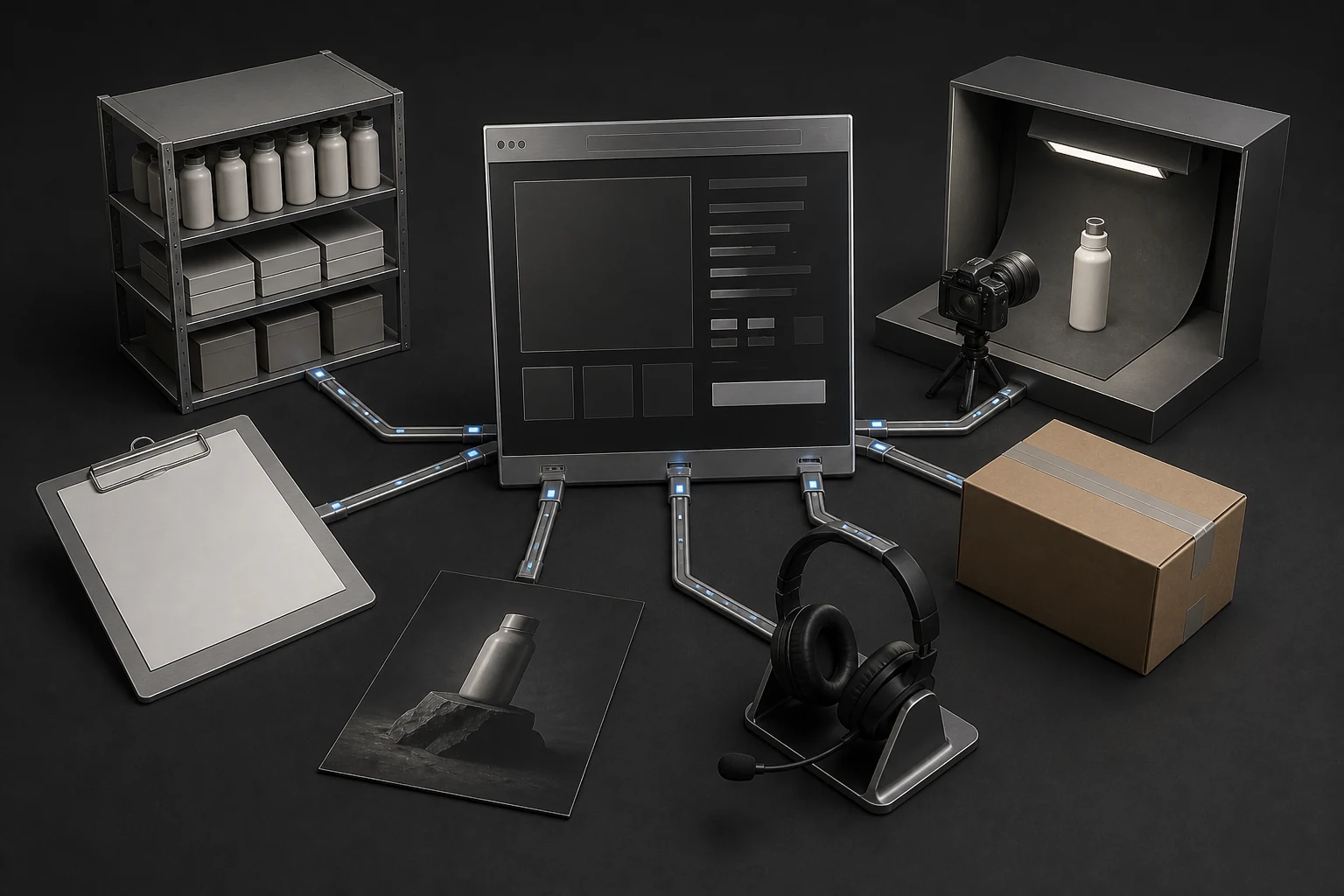
An authored plate of a storefront connected to the catalogue and operations around it.

Put AI to work on the jobs taking up your day.

We add AI to commerce and operational workflows when it can handle a defined judgement task better than a rule or existing product. One person remains accountable for the system.

We build stores, websites and web applications.

AI is not the default answer

Deterministic rules are cheaper and easier to test. Existing products are cheaper to own than custom software. We check both before proposing an AI build.

AI earns its place when the input varies enough to need judgement, the result can be checked and the workflow has a safe route for uncertainty.

Work we can scope

  • product data classification and draft enrichment queued for approval;
  • support or document triage that routes work before a person replies;
  • structured extraction from variable documents;
  • reconciliation support where records need comparing and exceptions need surfacing;
  • AI features inside an application the business already uses.

Controls agreed before build

  • which inputs the model can receive;
  • what it may draft, classify or recommend;
  • which actions always need human approval;
  • confidence or validation rules for uncertain output;
  • a named manual route when the AI step is unavailable or unsuitable;
  • logs showing input, output and account;
  • provider and API cost limits per workflow;
  • how the AI step can be switched off without breaking the underlying process.

We test incorrect, ambiguous and failed results as well as good examples, so the system knows when to ask for human help.

Money

What this work starts at

Build

Scoped after discovery

Software, not a site

Web application or Shopify app

From £4,000From $5,200

Authentication, application behaviour, relational data, private merchant tooling or a custom Shopify app. Requirements beyond what a marketing site or a theme can hold.

  • Private dashboards and merchant workflows
  • Admin API integrations and signed webhooks
  • Relational data, accounts and permissions
  • Maintenance ownership agreed before build

Starting price · scoped after discovery

AI application delivery starts at £4,000 after discovery. Discovery is quoted separately and credited against the build if you proceed. Model and API usage is separate and depends on the provider and volume. Prices exclude VAT.

Questions

Your questions

What does an AI developer do?

Turns a defined business requirement into software that uses a model where judgement is genuinely needed. Most of the work is the ordinary part: the interface, the integrations, the permissions, and the checks that catch a wrong answer before anyone acts on it.

Do we actually need AI for this?

Often not, and it is worth establishing first. A fixed rule is cheaper and more predictable, and an existing product may already do it for a subscription. AI earns its place where the input is language, the case needs judgement, or the information arrives differently every time.

Can you add AI to software we already run?

Where it has an API and permissions can be scoped, usually yes. We review what the system will let a new component read and write before confirming the approach, because that constraint shapes the design more than the choice of model does.

What happens when the model gets it wrong?

We assume it will. Before launch we measure it against a test set of your real cases and decide what each kind of error costs. The design follows from that: approval before anything is sent or written, a route to a person, and a log of what happened.

How much does an AI project cost?

AI application delivery starts at £4,000 after discovery, excluding VAT. Discovery is quoted separately and credited against the build if you proceed. Model and API usage is separate and depends on the provider and volume.

Should we hire a developer instead?

If you already have people to scope it, review the output and run it afterwards, a senior contractor may well be enough. Where nobody owns the workflow end to end, what is worth buying is one accountable party covering discovery, build, integration and a handover that names who runs it afterwards.

What happens to our data?

Before anything is connected, the scope names which data may be sent to a model provider and which must not. Provider retention and training terms are reviewed during model selection, and the agreed restrictions become acceptance criteria for the build.

Who owns the code and the prompts?

You do, on the terms set out in the agreement. Ownership, and what happens to prompts and configuration at handover, is settled in writing before the build starts rather than left to assumption.

Do you only do this for Shopify businesses?

No. The pattern holds wherever the workflow lives: a catalogue, a helpdesk, a finance system or your own application. Commerce and operations are where we have the most context, which is why the examples on this page come from there.

Send the workflow you want to change.

How it runs today, who checks the work and where it goes wrong will tell us whether AI is the right answer at all.

Discuss a project